
As AI infrastructure accelerates hardware innovation and increases asset complexity, organizations need a more intelligent approach to managing security, accountability, and recoverable value.
For years, IT asset management has focused on a relatively straightforward set of priorities: knowing what equipment an organization owns, where it is located, how it is being used, and when it should be retired.
Those fundamentals remain essential. But for organizations operating large-scale data center infrastructure, they are no longer sufficient.
The rapid expansion of artificial intelligence, increasingly specialized compute architectures, and the growing economic significance of high-performance components are changing the decisions organizations must make throughout the technology lifecycle.
A server, GPU, memory module, or storage device is no longer simply an asset moving through a predictable acquisition-to-disposition process. It represents a combination of performance capability, remaining useful life, security considerations, recoverable components, and potential secondary-market value.
Yet the most consequential question may not be what an asset is worth.
It’s whether an organization can account for what happened to it—and prove that its data was protected.
AI Infrastructure Is Changing the Lifecycle Equation
Traditional enterprise infrastructure has generally followed established procurement, deployment, maintenance, and refresh cycles. Although those cycles continue to evolve, AI infrastructure introduces additional complexity.
GPU architectures advance rapidly. Memory and storage requirements change with workloads. High-performance systems incorporate specialized components whose economic value may extend beyond the useful life of their original configuration.
For hyperscalers, OEMs, and operators managing infrastructure across multiple facilities, these changes create several interconnected challenges.
Hardware obsolescence does not necessarily mean economic obsolescence. Equipment that no longer meets the requirements of one workload may retain substantial value in another application.
Component-level value can differ significantly from system-level value. A system that is no longer viable as a complete unit may contain recoverable GPUs, memory, storage, and other components with meaningful reuse potential.
Infrastructure scale amplifies operational inefficiencies. In environments processing thousands of assets, inconsistent intake, incomplete data, and manual testing can limit visibility and delay decisions.
Security requirements remain critical regardless of an asset’s residual value. Every data-bearing device must be handled through processes that protect sensitive information and produce verifiable evidence of its disposition.
These realities challenge the assumption that lifecycle management can be optimized primarily through inventory records, depreciation schedules, and standardized disposition processes.
From Asset Tracking to Asset Intelligence
Traditional ITAM systems are designed to provide visibility into asset ownership, location, configuration, and status.
But knowing that an asset exists is different from understanding its actual condition, performance, security status, and economic potential.
Consider two identical GPU servers being removed from production. Both may share the same manufacturer, model, configuration, and deployment date.
Yet their recoverable value could differ considerably based on component health, performance characteristics, and the condition of individual subsystems.
An inventory record alone cannot capture those differences.
Engineering-grade testing, diagnostics, and component-level evaluation can provide a more complete picture, helping organizations determine whether equipment should be redeployed, refurbished, remarketed, harvested for components, or responsibly recycled.
Equally important, the information generated through these processes should remain connected to the asset’s identity and handling history.
This represents an important evolution in lifecycle management: moving from tracking assets through predefined stages to making informed, documented decisions based on their actual characteristics.
Data Accountability Doesn’t End When Equipment Leaves the Facility
As secondary markets for high-performance computing equipment expand, organizations face an increasingly complex challenge: maximizing the value of retired infrastructure while maintaining confidence in how data-bearing assets are handled.
For hyperscalers, OEMs, and global enterprises, the financial opportunity associated with equipment recovery can be significant. But the consequences of losing control over sensitive data can far outweigh any potential recovery value.
An asset’s value can be recovered. A failure to protect its data cannot be undone.
That makes verifiable data sanitization, destruction, and chain of custody fundamental requirements of an effective lifecycle strategy.
Organizations need more than assurances that equipment has been securely processed. They need an auditable record of what happened to each data-bearing device, including its identification, handling, sanitization or destruction method, verification results, and documented outcome.
Certificates of data sanitization or destruction provide essential evidence, but their value depends on the integrity of the processes and records supporting them.
As infrastructure volumes increase and assets move through more complex recovery workflows, maintaining that level of accountability becomes more challenging—and more important.
Intelligent lifecycle management brings these requirements together, connecting asset-level tracking, secure processing, and verifiable documentation with the technical capabilities needed to evaluate and recover equipment value.
The objective is not to choose between security and recovery.
It is to ensure that recovery never compromises accountability.
The Hidden Cost of Fragmented Lifecycle Processes
For many organizations, the technology lifecycle involves multiple systems, service providers, and operational handoffs.
Asset information may originate in procurement or configuration management systems, move through deployment and maintenance records, and eventually be transferred into disposition workflows.
At each transition, information can be lost, duplicated, or disconnected from the physical asset.
The consequences extend beyond administrative inefficiency.
Incomplete asset-level information can make it harder to verify chain of custody, demonstrate secure data handling, assess recoverable value, identify reuse opportunities, and produce consistent reporting.
For organizations operating at hyperscale, even relatively small process inefficiencies can become significant when multiplied across facilities, equipment categories, and transaction volumes.
A fragmented process also creates challenges when an organization needs to reconstruct an asset’s history for an internal audit, customer inquiry, or compliance review.
The opportunity lies in connecting physical asset processing with reliable, consistent data from the point of intake through final recovery or disposition.
Chain of custody should be more than a record of where an asset has been. It should support confidence in every decision made about that asset.
Recovery Value Is Becoming a Strategic Consideration
Historically, technology disposition has often been approached as an operational requirement: remove equipment securely, meet compliance obligations, and recover whatever residual value is available.
But as compute infrastructure becomes more specialized and component values become more variable, recovery decisions deserve greater attention earlier in the lifecycle.
Organizations need to understand not only what equipment can be sold or recycled, but which recovery pathways create the greatest potential value without compromising security requirements.
That may include extending the useful life of complete systems, qualifying components for reuse, recovering valuable memory and storage devices, or identifying secondary-market opportunities for specialized hardware.
These decisions depend on technical capabilities as much as commercial expertise.
For example, identifying a potentially valuable component is only the beginning. Testing, grading, appropriate data sanitization, and verification help establish whether it can be reliably and securely returned to productive use.
The ability to evaluate equipment at a more granular level can turn disposition from a largely transactional process into a deliberate value optimization strategy.
But recovery value should never be considered in isolation.
The strongest lifecycle strategies establish security and accountability as foundational requirements, then use asset intelligence to identify the best recovery opportunities within those parameters.
Sustainability Requires Better Asset-Level Decisions
The growing environmental impact of digital infrastructure adds another dimension to lifecycle management.
As organizations expand AI and cloud capacity, they face increasing pressure to demonstrate responsible resource use, extend equipment life where practical, and reduce unnecessary waste.
Yet sustainability outcomes cannot be optimized through recycling metrics alone.
Reuse, refurbishment, and component recovery can preserve the utility of existing technology, potentially reducing the need for new manufacturing and associated resource consumption.
Determining the most appropriate pathway requires accurate information about equipment condition, functional performance, security status, and recovery potential.
This creates a direct relationship between operational intelligence, economic recovery, and sustainability performance.
Rather than treating these as separate objectives, organizations can evaluate them together as part of a coordinated lifecycle strategy.
What Intelligent Lifecycle Management Looks Like
The next evolution of lifecycle management is not simply another software platform or asset tracking system.
It is the integration of technology, engineering expertise, operational execution, and analytics to support better decisions throughout the asset lifecycle.
For organizations evaluating their capabilities and partners, several questions become increasingly important:
- Can every asset be accurately identified and tracked from initial receipt through final disposition?
- Can the organization produce an auditable record of how each data-bearing device was handled, sanitized, or destroyed?
- Are chain-of-custody records, verification results, and certificates connected to individual asset records?
- Can engineering-grade testing establish actual functional condition rather than relying solely on configuration or age?
- Can individual components be evaluated for recovery, reuse, and remarketing opportunities?
- Can asset-level information support consistent reporting and recovery decisions across locations?
These capabilities become particularly valuable when managing large volumes of diverse, high-value infrastructure.
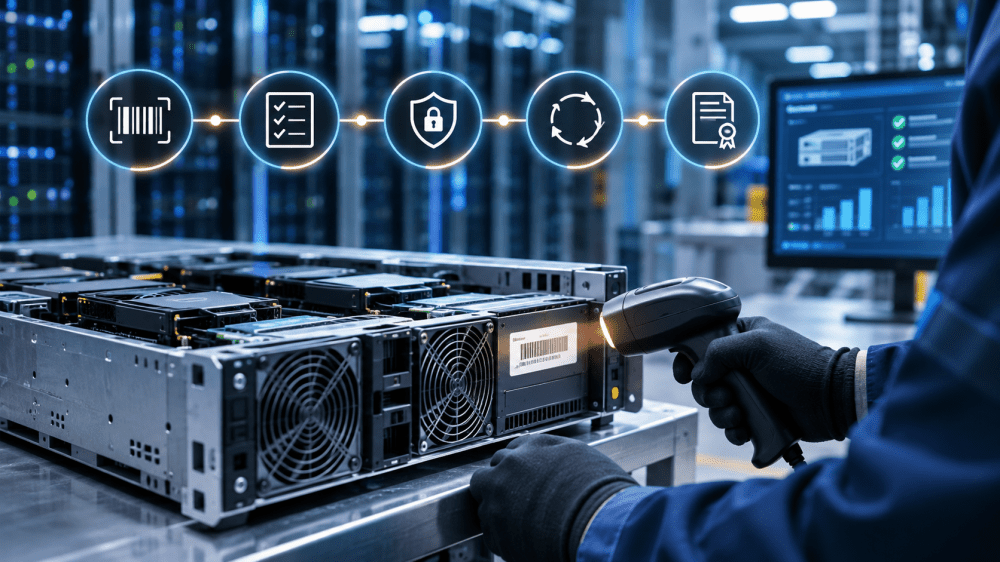
At illumynt, this philosophy informs the development of Talorem®, our integrated technology suite connecting intelligent intake, engineering-grade testing, secure storage processing, component recovery, and lifecycle analytics.
Through its five capabilities, IRIS, Qualify, X, Xtract, and Insight, Talorem is designed to bring greater intelligence and consistency to asset processing and recovery decisions.
The broader objective is to move beyond conventional disposition processes toward a more connected, informed, and accountable approach to technology lifecycle management.
The Next Competitive Advantage Is Lifecycle Intelligence
As AI infrastructure continues to evolve, the organizations that manage technology most effectively will not necessarily be those that refresh equipment fastest or recover the highest volume of materials.
They will be those that understand their assets at a deeper level, maintain confidence in how those assets are handled, and can act on that intelligence.
That means knowing when equipment should remain in service, when it can be redeployed, which components retain value, and how recovery decisions affect both economic and environmental outcomes.
It also means being able to demonstrate that sensitive data was protected throughout the process.
Traditional ITAM provides the foundation.
Intelligent lifecycle management builds on that foundation—with security and auditability as essential requirements, asset intelligence enabling better decisions, and value recovery as a measurable outcome.
For organizations managing the next generation of compute infrastructure, that distinction is becoming increasingly important.
illumynt delivers intelligent, technology-driven lifecycle solutions for organizations managing complex, high-value technology infrastructure. Learn more about the Talorem platform.